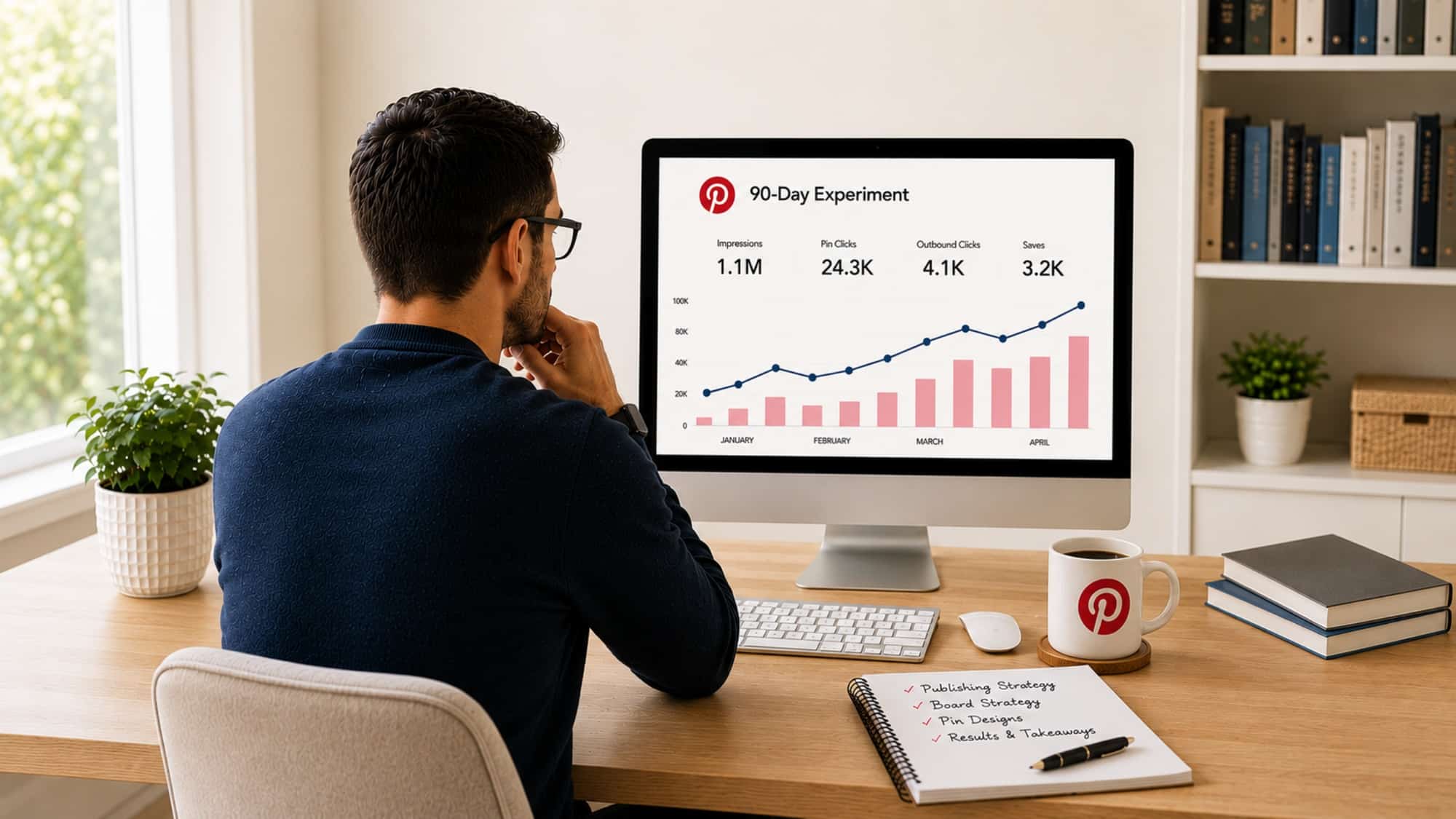
In early February 2026, I noticed something concerning happening on my Pinterest account.
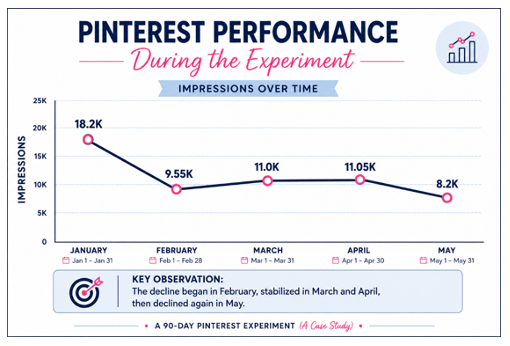
After a strong January, my analytics began to decline. Impressions, engagements, outbound clicks, saves, and engaged audience numbers all moved downward.
Interestingly, at about the same time, I began hearing similar reports from other Pinterest educators and marketers about declines in their analytics—not only for their own accounts, but for client accounts as well.
Rather than immediately jumping to conclusions (or ignoring it and hoping it would get better), I decided to run an experiment.
For the next 90 days, I simplified my Pinterest strategy. I had always wondered whether publishing a higher volume of pins across multiple boards was really making a difference. This experiment gave me an opportunity to test that curiosity.
As part of the experiment, I reduced publishing volume, stopped distributing pins to multiple boards, focused on creating unique pins, and closely monitored both Pinterest Analytics and Tailwind Analytics.
I know, crazy, right?
This post is not intended to prove a new Pinterest strategy. It is simply a look at what happened on my account, what I changed, what I observed, and a few surprises along the way.
A Few Notes Before We Begin
Before looking deeper at the approach and data, I think it’s helpful to provide some context.
This experiment was conducted on my own Pinterest account, which focuses primarily on Pinterest marketing and education. I am not a Pinterest educator, but as a Pinterest Marketing Specialist and Strategist, I test quite a bit and enjoy sharing what I learn, just as others have shared their findings with me over the years.
Given my niche, Pinterest marketing is relatively small compared to broader Pinterest categories such as recipes, home decor, fashion, travel, or DIY.
I also intentionally changed my board publishing strategy during the experiment. No new boards were created, and my board structure remained unchanged throughout the testing period.
The experiment itself ran from March 1 through May 31, 2026, following that noticeable decline that began in February.
Most importantly, this is a case study, not a set of Pinterest rules. My observations may differ from yours because every Pinterest account, niche, audience, and content library is different.
My January Baseline
January 2026 provided a strong starting point:
- Impressions: 18.2K
- Engagements: 1.01K
- Outbound Clicks: 105
- Saves: 575
- Total Audience: 10.73K
- Engaged Audience: 278
Publishing volume during January was 110 pins.
At the time, my typical workflow included publishing fresh pins regularly and distributing content across multiple relevant boards.
The February Decline
Things changed quickly in February.
Despite publishing 145 pins—the highest monthly volume during the entire period—my analytics dropped significantly:
- Impressions: down 42%
- Engagements: down 45%
- Outbound Clicks: down 39%
- Saves: down 57%
- Total Audience: down 59%
This was one of the first clues that publishing volume alone was not driving performance.
While I cannot say with certainty what caused the shift, the timing made me question whether something larger than my individual account may have been occurring.
The Changes I Made
Beginning in March, I made several intentional changes.
What Changed
- Reduced distribution to one board per pin
- Stopped distributing the same URL to multiple boards
- Focused on creating unique pins
- Reduced overall publishing volume
- Continued publishing new blog content
- Kept my existing board structure unchanged
One of my primary goals was to finally test that question I had been wondering about for years:
Does distributing a URL to multiple boards really matter?
Questions like “How many pins should I publish each day?” and “Does posting to multiple boards still matter?” have been discussed within the Pinterest community for years.
Rather than relying on opinions, I wanted to test some of those assumptions on my own account.
Publishing Volume During the Experiment
Here is the actual number of pins published each month according to Tailwind:
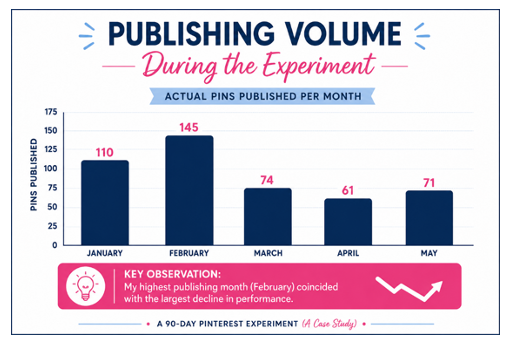
One of the more surprising observations was that my highest-volume month coincided with the largest decline, while some of my strongest engagement improvements occurred during lower-volume months.
This reinforced something I’ve long suspected (and known):
Publishing volume is only one variable among many.
What Happened Next
March
After reducing both publishing volume and board distribution, performance began to stabilize.
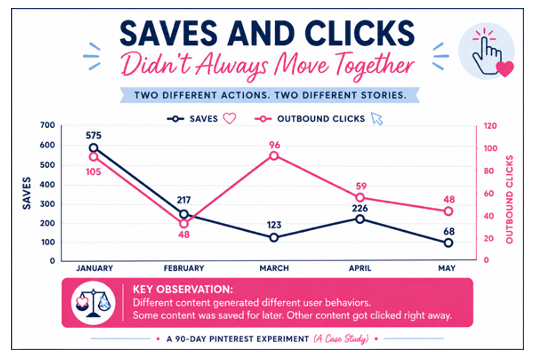
While impressions remained below January levels, outbound clicks improved significantly. At one point, outbound clicks increased by more than 70% compared to the prior period.
This suggested that the people seeing my content were more likely to take action.
April
April introduced a different pattern.
Engagements increased. Saves increased. However, outbound clicks declined.
This was one of the most interesting findings of the experiment because it highlighted something I don’t think gets discussed enough:
Not all engagement is the same.
Some content encouraged people to click immediately. Other content encouraged them to save the content for later.
May
In May, I increased publishing slightly while continuing the one-board-per-pin approach.
I also missed several publishing days throughout the month due to workload and scheduling constraints.
Performance declined again, reinforcing another important observation:
Consistency still appears to matter.
The Biggest Surprise
Going into this experiment, I expected the biggest lesson to be about posting frequency.
Instead, I found myself paying more attention to the difference between content Pinterest chose to distribute and content users chose to engage with.
Those were not always the same thing.
The Difference Between Distribution and Engagement
One of the most surprising discoveries came when I compared Pinterest Analytics with Tailwind Analytics.
At first glance, my article about creating Vision Boards with Pinterest Collages appeared to be the clear winner.
That article consistently ranked near the top for:
- Impressions
- Pin Clicks
- Outbound Clicks
- Overall Engagement
Pinterest clearly understood who wanted that content.
However, when I reviewed my individual pin performance in Tailwind, a different story emerged.
A newer article, Instagram + Pinterest: What’s Changed and What to Know, generated some of the strongest individual pin performance during the entire experiment.
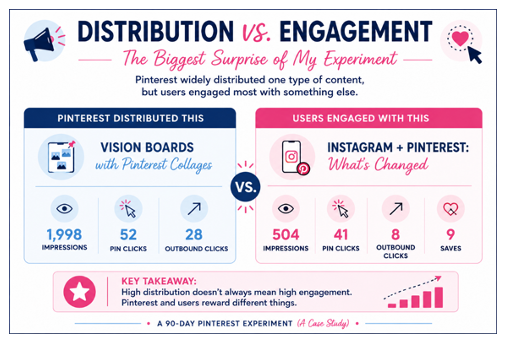
One pin generated:
- 504 impressions
- 41 pin clicks
- 8 outbound clicks
- 9 saves
Despite receiving far less overall distribution than the Vision Board content.
This led me to an important distinction:
Pinterest appeared to trust and distribute some established URLs more aggressively, while users often responded very positively to newer content when they actually saw it.
What I Learned
After 90 days, these are the observations I feel most comfortable sharing.
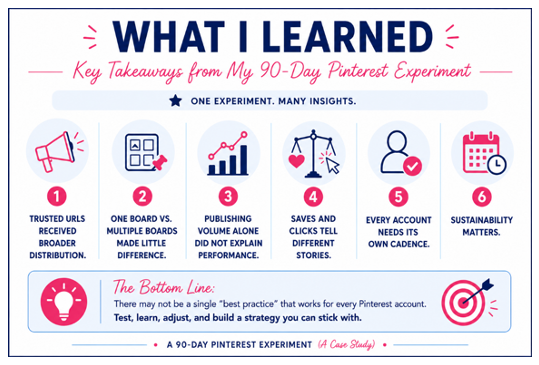
Pinterest Appeared to Favor Trusted URLs
Older content with an established history often received broader distribution than newer content.
Distribution and Engagement Are Not the Same Thing
Some content performed extremely well when users saw it, even if Pinterest distributed it less frequently.
Saves and Clicks Serve Different Purposes
Some content generated saves. Other content generated clicks. The two did not always move together.
Reducing Board Distribution Did Not Appear to Hurt (or Help) My Account
One of the biggest questions going into this experiment was whether moving from multiple boards to a single board would negatively impact performance.
After 90 days, I did not see evidence that this change had a meaningful impact one way or the other.
There Is No Universal Answer to “How Many Pins Should I Publish?”
This may have been the biggest confirmation and takeaway.
My highest-volume month was also my weakest-performing month.
Meanwhile, some of my strongest engagement occurred during lower-volume months.
Rather than finding a magic number, I came away confirming my long-held belief that every account must find a publishing cadence that works for its niche, audience, creator, and business goals. That cadence may even vary between accounts in the same niche.
Sustainability Matters
Creating large numbers of completely unique pins every month is time-consuming, even with templates.
While there may be benefits to creating unique content, the experiment also raised important questions about what is sustainable for bloggers, business owners, and Pinterest managers over the long term.
What This Experiment Did Not Prove
Just as important as what I learned is what I did not learn.
This experiment does not prove:
- That one board per pin is best.
- That multiple-board distribution no longer works.
- That Pinterest no longer rewards fresh content.
- That every Pinterest account should reduce publishing volume.
- That my results will apply to your account.
Pinterest is constantly evolving. Features change, distribution patterns shift, and user behavior adapts over time.
For that reason, I view experiments like this as snapshots in time rather than permanent best practices.
Final Thoughts
The biggest lesson from this experiment wasn’t that I discovered a new Pinterest strategy.
It was that Pinterest continues to evolve and that testing assumptions on your own account can be incredibly valuable.
I finally answered a question I had been wondering about for years regarding one-board versus multiple-board distribution. I gained a better understanding of the difference between content Pinterest distributes and content users engage with. And perhaps most importantly, I was reminded that there may not be a single best practice that works for every Pinterest account.
Sometimes the most useful insights come not from finding answers, but from asking better questions.
For now, I’ll continue testing, observing, and sharing what I learn along the way.
And who knows? If Pinterest changes again next month, there may be another case study waiting to be written.
Let’s Work Together
If you want to put more focus on your Pinterest marketing and need strategic support, reach out or take a look at my Pinterest Management Packages to see how I work.
Prefer DIY?
Get my Free Pinterest Business Account Quick Start Checklist to make sure your account is set up correctly from the start.
For a deeper dive, check out my How-To Guide to Use Pinterest to Attract Clients and Sales.
Share: